.png)

When developer Jonathan Dodson and his partners began work in Oklahoma City’s historic Eastside, they rethought several elements of the traditional development model. A respected community leader was brought into the ownership structure and granted veto authority over major decisions for the EastPoint project. Tenants were offered a collective 15 percent equity stake in the project. Tax increment financing proceeds were redirected toward larger tenant improvements and lower rents, rather than toward maximizing developer returns.
Located along Northeast 23rd Street, roughly a mile east of the state capitol, EastPoint consists of an 18,000 square foot (1,672 sq m) property linked to a 20,000 square foot property in a corridor that experienced decades of disinvestment. One site previously operated as a gas station. The other sat within a historic commercial district that once served as a hub for Oklahoma City’s Black community.
Along Northeast 23rd Street, Black-owned businesses, churches, and civic life all thrived during segregation. Decades of redlining, urban renewal, and highway construction systematically stripped wealth and investment from the neighborhood while also displacing residents and fracturing community networks. The Eastside experienced generations of disinvestment, leaving many residents without access to fresh food, health care, or new commercial development.
Attempting to address this injustice, the city approached the Pivot Real Estate Development team in 2017 as part of the broader MAPS for Neighborhoods initiative, an extension of Oklahoma City’s long-running Metropolitan Area Projects (MAPS) program, which has funded major civic investments through a dedicated penny sales tax.

The East Point development in Oklahoma City includes a grocery store operated through a nonprofit/private partnership, a think tank, health care services, and a collection of local retail businesses. Yet the development team also recognized that simply filling storefronts would not address the deeper economic barriers facing local entrepreneurs.
(East Point Market)
Community Governance and Local Investment
Many residents perceived previous development and public investment decisions were made without meaningful input from neighborhood stakeholders, thus reinforcing local skepticism toward outside investment. Building trust would become one of the EastPoint team’s first challenges.
“The idea was that the community representative could speak on behalf of the project,” Dodson said. “We wanted someone at the table who could stop the project if it stopped reflecting community priorities.”
The development team also conducted extensive community engagement to understand what residents wanted from new investment. The feedback was clear—residents wanted access to health care, fresh food, and retail businesses that reflected the community itself. The neighborhood was long considered a food desert, and many residents expressed frustration that redevelopment elsewhere in Oklahoma City failed to deliver meaningful benefits to the Eastside.
Those conversations shaped both the project’s tenant mix and financing structure. VIPcare Centennial Health, a century-old health care facility formerly known as OKC Clinic, agreed to relocate its headquarters from downtown Oklahoma City into approximately 10,000 square feet (930 sq m) of the project’s first building. VIPcare Centennial Health believed in the EastPoint project vision and provided a stable anchor tenant and critical community service.
The completed project now includes a grocery store operated through a nonprofit/private partnership, a think tank, health care services, and a collection of local retail businesses. Yet the development team also recognized that simply filling storefronts would not address the deeper economic barriers facing local entrepreneurs. “We were trying to create something that would lay a foundation for people within the neighborhood to actually redevelop their own community,” Dodson said.
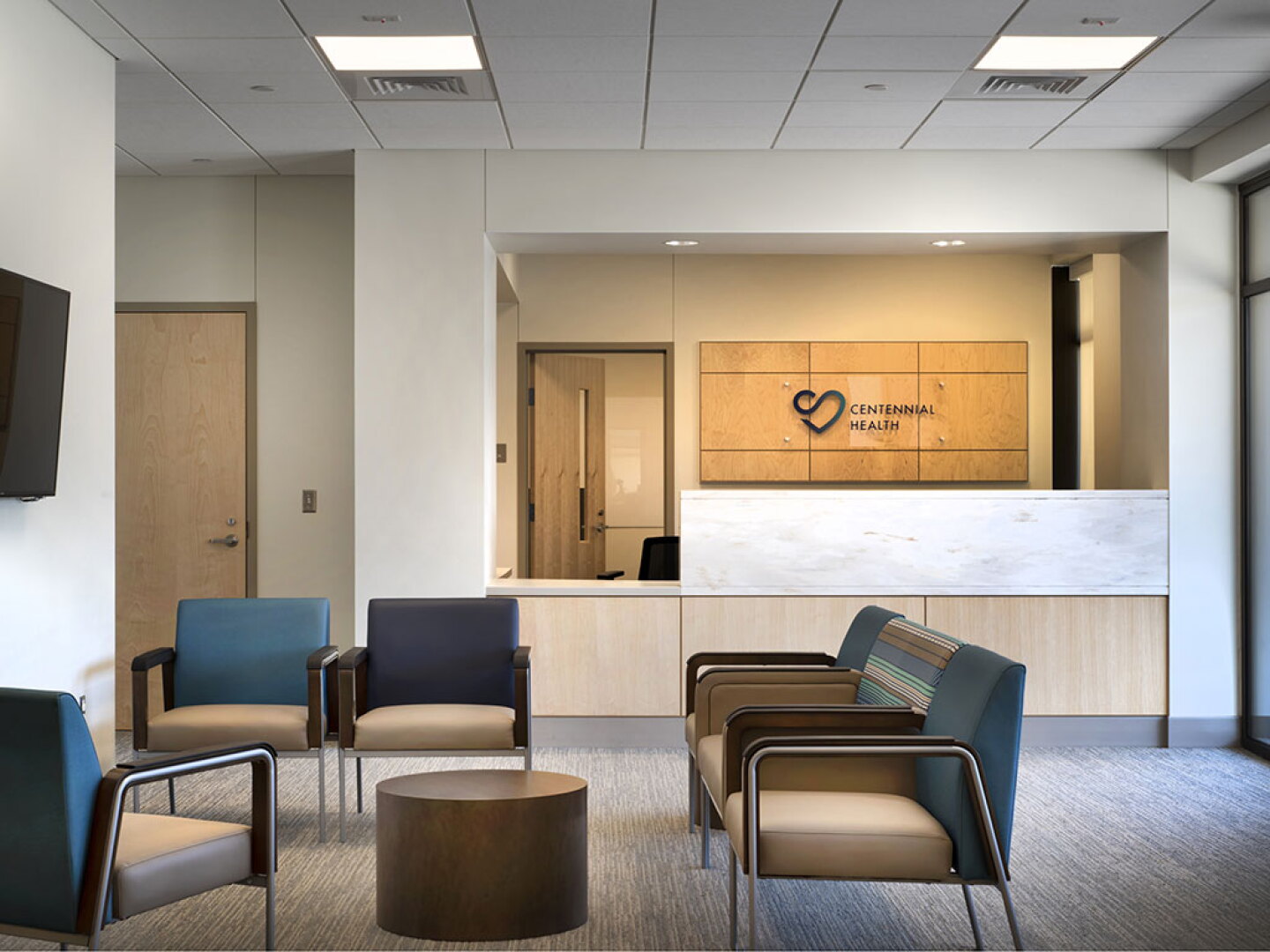
VIPcare Centennial Health, a century-old health care facility formerly known as OKC Clinic, agreed to relocate its headquarters from downtown Oklahoma City into approximately 10,000 square feet (930 sq m) of the project’s first building. VIPcare Centennial Health believed in the EastPoint project vision and provided a stable anchor tenant and critical community service.
Tenant Ownership and Community Wealth Building
To support community ownership and reduce displacement pressures, the Oklahoma City municipal government granted the development team$2.5 million in city tax increment financing (TIF). These proceeds were then directed toward tenants, rather than toward developer returns. Working with the city, the team used TIF proceeds to fund larger tenant improvement packages and lower rents for local businesses. Tenants received five to six times the typical tenant improvement allowances, even as rents were reduced by roughly 30 percent below comparable rates elsewhere in the city.
The team also avoided relying on traditional brokerage channels. Instead, community members received consulting fees for identifying and helping to recruit tenants. Over the course of the project, the development team has paid approximately $30,000 to $40,000 in referral fees, effectively allowing community members to help curate the retail mix.
Most notably, tenants were offered a collective 15 percent equity stake in the project from the outset. If tenants fulfilled the terms of their leases, they would receive their share of proceeds upon the eventual sale of the property.
The structure was designed to align incentives between tenants and ownership while helping residents participate in some of the value created by redevelopment. “If the building succeeds, they succeed,” Dodson said. “It changes the relationship from landlord and tenant to co-owners trying to build something together.”
The project ultimately exceeded its goal of securing 60–70 percent minority-owned tenants, reaching closer to 80–90 percent at lease-up. Yet even with strong community support and a long-term health care anchor tenant in place, financing the project proved extraordinarily difficult.
Financing Challenges in Historically Disinvested Neighborhoods
Each phase of EastPoint cost roughly $4.25 million to develop, with approximately $2.65 million financed through debt. Even with a low loan-to-cost ratio and a long-term health care lease in place, more than 25 banks declined to finance the project or refused to lend in that part of Oklahoma City altogether. “One bank told us they would only do the deal if someone richer than us guaranteed the loan,” Dodson recalled.
Citizen’s Bank of Edmond, a woman-led bank located in an Oklahoma City suburb, agreed to finance the development with the support of an outside guarantor. Yet the experience reinforced what Dodson sees as one of the greatest barriers to equitable development in many cities. “The big issue is lack of access to capital for these projects,” he said.
Because few comparable projects existed nearby, the completed buildings continue to be appraised significantly below development cost, despite strong occupancy and community demand. The absence of comparable sales and valuations further constrains financing opportunities for future projects in historically disinvested neighborhoods.
Supporting Small Business Development
Although the health care and grocery components of EastPoint have largely succeeded, the retail side of the project has faced substantial challenges. More than 40 letters of intent were initially signed for the project’s 11 retail spaces, but many prospective tenants were unable to secure the startup capital (often $15,000–$20,000).
“We asked ourselves,” Dodson said, “‘How can a 20-year-old Black entrepreneur on the East Side find $20,000?’ It’s not easy, given the deep legacy of systemic racism and redlining.
As a result, the development team repeatedly re-leased spaces, often relying on entrepreneurs with passion and vision but limited operational experience. Those difficulties intensified during the Covid-19 pandemic, which devastated many small businesses nationwide and created additional instability within the corridor.
Dodson said the experience revealed how deeply layered disinvestment can be: “You can’t expect one building to reverse 35 years of economic neglect. You see first-hand that a rising tide doesn’t lift all boats. It floods all the boats that have holes in them.”
The team learned that supporting local businesses required more than affordable rent or community enthusiasm. Retail operators also needed operational training, marketing support, grant-writing assistance, and long-term mentorship. In several cases, tenants were allowed to remain in their spaces for more than a year without paying rent as the developers attempted to stabilize businesses through the most difficult periods of the pandemic and recovery. “We needed to wrap in so many other services that we just were not aware of going in,” Dodson said.
Although EastPoint’s rents were already substantially below ones in wealthier parts of Oklahoma City, Dodson believes they were still too high for many neighborhood entrepreneurs to sustain without additional subsidy.
“If we could do it again, we would ask the city for more money up front to fully build out tenant spaces,” he said. “For a lot of these entrepreneurs, ‘skin in the game’ meant risking everything they had.”
Building Long-Term Community Wealth
Today, EastPoint continues to evolve as the team works to re-tenant several spaces with operators who bring strong operational capacity while maintaining the project’s community-centered mission. Alongside the real estate itself, EastPoint helped inspire broader community capacity-building efforts, including PlaceKeepers, a real estate training initiative developed in partnership with the Urban Land Institute that teaches community members about development processes and ownership models.
Ultimately, Dodson hopes the project can transition to Black-led ownership in the future and reflect the development’s larger goal of building long-term community wealth rather than permanent outside control.
The lessons from EastPoint can extend far beyond Oklahoma City. Many mid-sized cities face similar challenges—strong local vision and leadership, significant opportunity for community-changing projects, and a severe lack of accessible capital for these initiatives.
Dodson believes that less than $10 million in the right hands could completely change a place like Oklahoma City.
Projects like EastPoint demonstrate both the possibilities and challenges of equitable development. EastPoint succeeded in creating community-serving spaces, expanding minority business ownership, and introducing innovative ownership structures. At the same time, it exposed how difficult it can be to sustain small businesses in neighborhoods shaped by decades of redlining and disinvestment without broader systems of support.
For developers pursuing similar work, Dodson believes the most important lesson is to recognize that community engagement alone is not enough. Equitable redevelopment also requires effective capital, operational support systems, and a willingness to rethink traditional development incentives. “Development can’t just be about building space,” he said. “It has to be about building ecosystems.”
Funding for this article was made possible by the Robert Wood Johnson Foundation.
.png)
.png)
